Fabric Scrap Hearts for Valentine’s Day
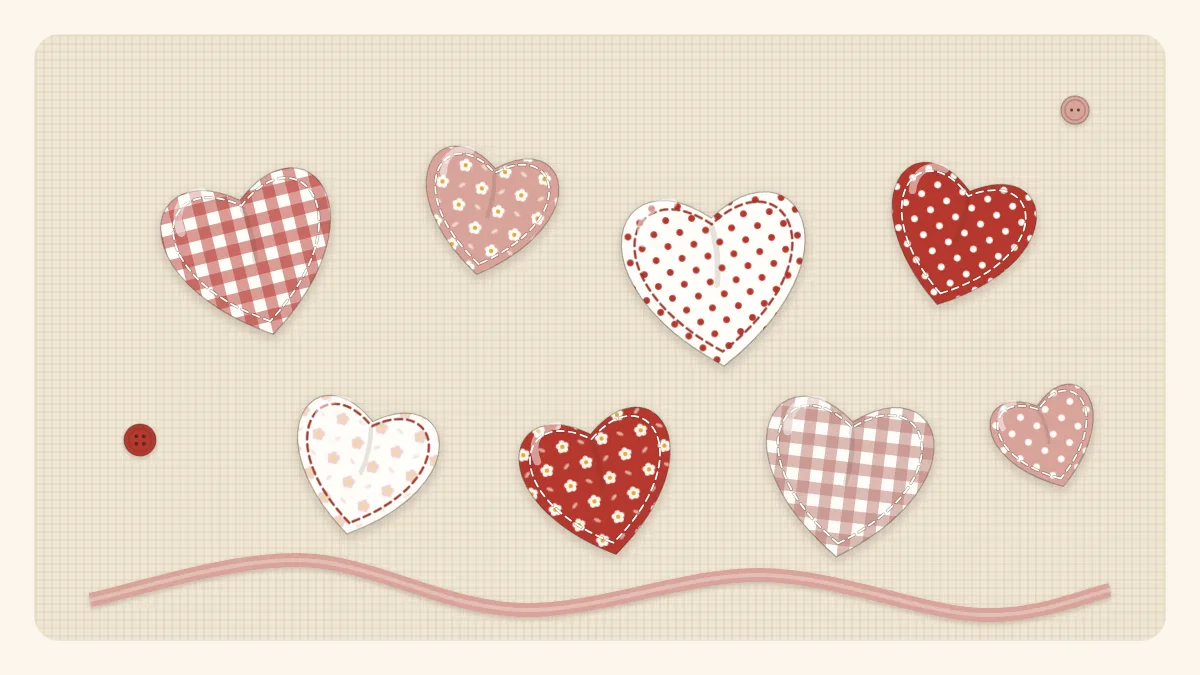
Small stuffed hearts, plain or patchwork, with smooth clipped curves. String them as a garland, pile them in a bowl or tuck one in a pocket.
Project at a glance
Materials
- Cotton fabric scraps
- Paper and pencil for the template
- Polyester fiberfill, wool roving or fabric trimmings
- Thread, pins and a hand-sewing needle
- Small sharp scissors
- Chopstick or blunt pencil
- Twine and a large-eye needle for a garland (optional)
A small shape with a lot of uses
Stuffed fabric scrap hearts are quick to sew and endlessly useful: a bowl of them on a table, a string across a mantel, one tucked into a coat pocket or a lunch box. Each heart takes two scraps about the size of your palm, and the sewing is a single seam. The only real skill involved is handling the curves and the dip at the top, and that comes down to careful clipping before you turn the heart right side out.
Sizes and cutting list
The templates below are finished sizes. You trace the heart onto the fabric and sew on the traced line, so no seam allowance is added to the template itself.
| Heart | Template (finished size) | Cut 2 fabric pieces |
|---|---|---|
| Standard | 4 in wide x 3.5 in tall (10 x 9 cm) | 5 x 4.5 in (13 x 11.5 cm) |
| 2.5 in wide x 2.25 in tall (6.5 x 5.5 cm) | 3.5 x 3.25 in (9 x 8.5 cm) |
You will also need:
- Paper or thin card for the template
- A pencil or removable fabric marker
- Polyester fiberfill
- Thread, pins, a hand needle and small sharp scissors
- A chopstick or blunt pencil
- Twine or narrow ribbon for a garland (optional)
Drawing a symmetrical heart template
- Cut a paper rectangle 4 x 3.5 inches (10 x 9 cm) and fold it in half so it measures 2 x 3.5 inches (5 x 9 cm).
- Starting at the fold about 1/2 inch (1.3 cm) below the top, draw half a heart: up and over in a rounded lobe that touches the top and the open side of the paper, then down in a gentle curve to a point at the bottom of the fold.
- Cut along the line through both layers and unfold.
A slightly rounded bottom point and a shallow dip at the top are far easier to sew and turn than a sharp point and a deep V. Make the pocket template the same way from a 2.5 x 2.25-inch (6.5 x 5.5 cm) rectangle.
How to sew a stuffed fabric heart
- Trace. Place the two fabric pieces right sides together. Center the template on the wrong side of the top piece, trace around it and pin the layers together inside the line.
- Sew. Set the stitch length to about 2 mm. Begin on one of the straighter sides of the heart, roughly halfway down, and sew on the traced line all the way around. Go slowly around the lobes, stopping with the needle down to turn the fabric every few stitches. At the dip, stop with the needle down, lift the presser foot, pivot and continue. Stop 1.5 inches (4 cm) before your starting point to leave a gap for turning (1 inch / 2.5 cm on the pocket heart). Backstitch at both ends.
- Trim. Cut the heart out 1/4 inch (6 mm) outside the stitching. Leave the allowance a little wider, about 3/8 inch (1 cm), along the gap; it makes the edges easier to fold in later.
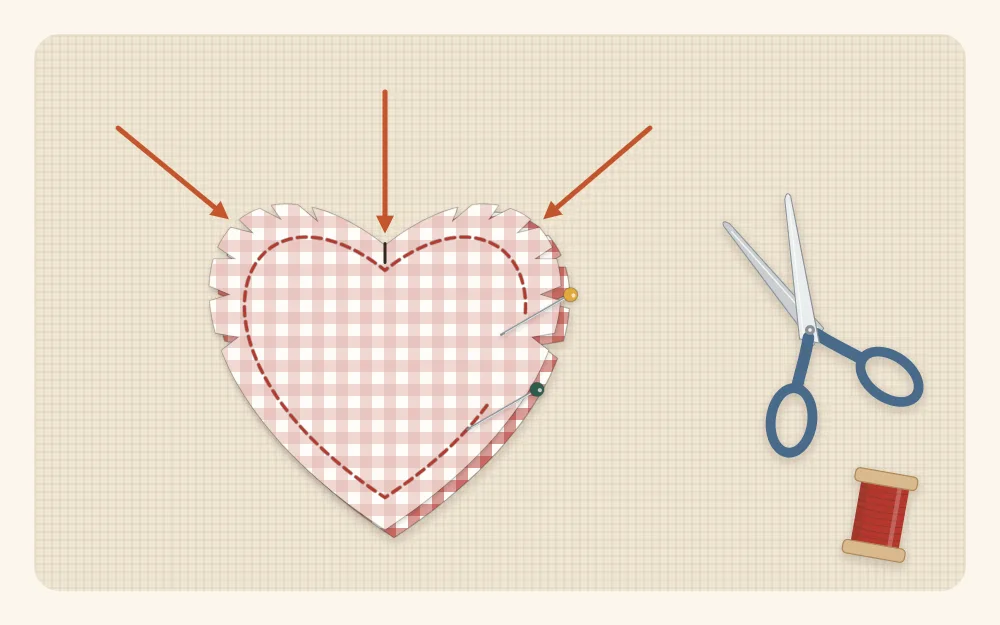
- Clip the curves. Cut small V-shaped notches out of the seam allowance all around both lobes, about 3/8 inch (1 cm) apart, stopping just short of the stitches. Snip straight down into the dip at the top, to within a thread or two of the stitching. Trim straight across the bottom point, 1/8 inch (3 mm) from the stitches.
- Turn. Turn the heart right side out through the gap. Run the chopstick around the inside of the seam to push the curves out fully, and ease out the bottom point. Press, folding the gap edges in along the traced line.
- Stuff. Use small pieces of fiberfill. Fill the two lobes and the point first, then the center. The heart should be gently rounded, with a smooth edge and no hollow at the dip.
- Close. Sew the gap shut with a ladder stitch, taking small, even bites from each folded edge, and pull the thread snug so the stitches disappear.
Tip
Why clip? When the heart is turned, the seam allowance on an outward curve has to fit into a smaller space, and it bunches into ridges unless wedges of fabric have been removed. At the dip the opposite happens: the allowance has to spread, and without a snip it pulls the top of the heart into a pucker.
Watch out
Clip with the tips of small scissors and watch the stitching line. A snip that cuts through the seam at the dip leaves a hole that opens up when the heart is stuffed. If it happens, turn the heart inside out again and sew a new line just inside the first.
Patchwork hearts
For a pieced front, sew the scraps into a small panel first and then treat that panel as one piece of fabric. Two options fit the standard heart:
- Four-patch: sew four 2.75-inch (7 cm) squares into a two-by-two block with 1/4-inch seams. The block measures 5 inches (13 cm) square.
- Strips: sew three strips, each 2 x 5 inches (5 x 13 cm), together along their long edges. The panel measures 5 inches (13 cm) square.
Press the seams well, and open rather than to one side to keep the heart flat. Either panel is large enough for the 5 x 4.5-inch front piece; pair it with a plain back, trace and sew as above. Use a shorter stitch, and backstitch wherever your stitching line crosses a patchwork seam near the gap. Accurate seams matter on something this small, so the basics in patchwork for beginners are worth a look first.
Ways to use the hearts
Garland
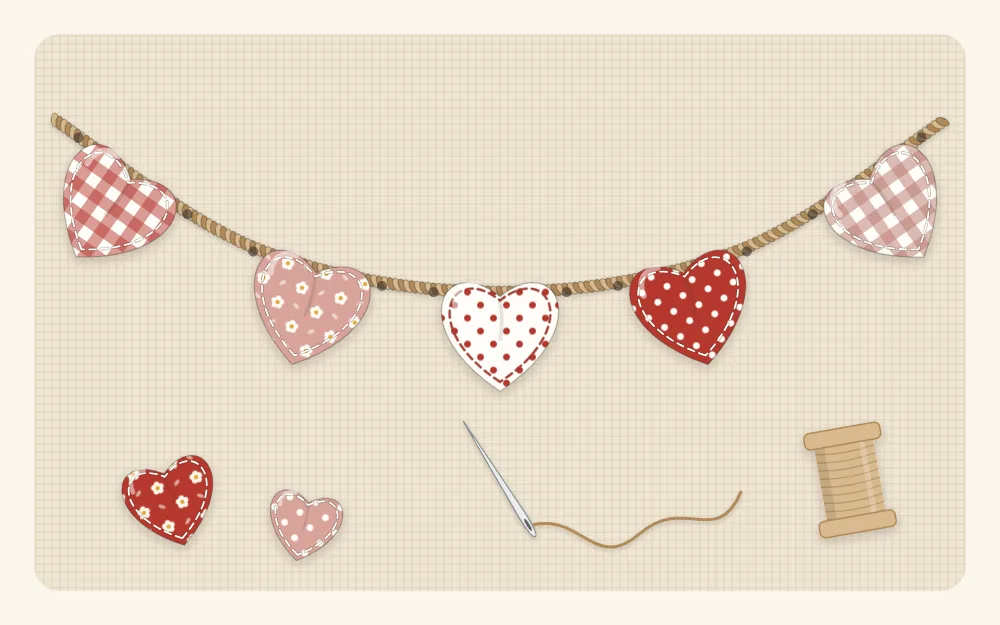
Thread a large-eyed needle with twine and pass it through the back of each heart, in one lobe and out the other, about 1/2 inch (1.3 cm) below the top edge. Space the hearts 3 to 4 inches (7.5 to 10 cm) apart. Seven standard hearts make a garland about 4 feet (1.2 m) long with a short tail of twine at each end for tying. Handmade fabric twine suits the job well.
Bowl fillers
Make a dozen or so in a limited palette, such as reds, dusty rose and cream, and mix both sizes. A spoonful of dried lavender in the stuffing turns them into scented fillers; the lavender sachets tutorial covers filling and refreshing dried buds.
Pocket hearts
The small size slips into a pocket, a card or a gift box as a keepsake. Stuff pocket hearts lightly so they stay fairly flat, and leave off buttons, beads and other small parts on any heart meant for a child. Scented hearts are not toys.
Common mistakes
- Gap on a curve. A gap left on a lobe is hard to close neatly. Always leave it on a straighter side.
- Overstuffing. Too much filling distorts the shape and strains the ladder stitch.
Frequently asked questions
Why do the curves on a fabric heart need clipping?
When a curved seam is turned right side out, the seam allowance on an outward curve has too much fabric and bunches up. Cutting small notches removes the excess so the lobes turn out smooth and round. The dip between the lobes needs a single straight snip so it can spread open.
Where should the turning gap go on a heart?
On one of the straight lower sides. A gap left on a curve is hard to close neatly and tends to bulge.
Can fabric hearts be sewn by hand?
Yes. Sew the seam with a small, even backstitch in place of machine stitching, then clip, turn, stuff and close with a ladder stitch as usual.
How are stuffed hearts strung into a garland?
Thread twine onto a large-eye needle and pass it through each heart from side to side, about 1/2 inch below the top of the lobes, spacing the hearts 3 to 4 inches apart. Threading near the top keeps the hearts hanging level.