Fabric Scrap Coasters: A Quilted Patchwork Set of Four
Sew a set of four quilted patchwork coasters from short strips, backing squares and thin batting, turned and topstitched with no binding.
Project at a glance
Materials
- 12 cotton scrap strips, 2 x 5 in (5 x 13 cm)
- 4 cotton backing squares, 5 x 5 in (13 x 13 cm)
- 4 squares of thin cotton batting, 5 x 5 in (13 x 13 cm)
- Cotton thread
- Rotary cutter, ruler and mat, or scissors
- Pins or clips
- Point turner or chopstick
- Removable fabric marker
- Iron
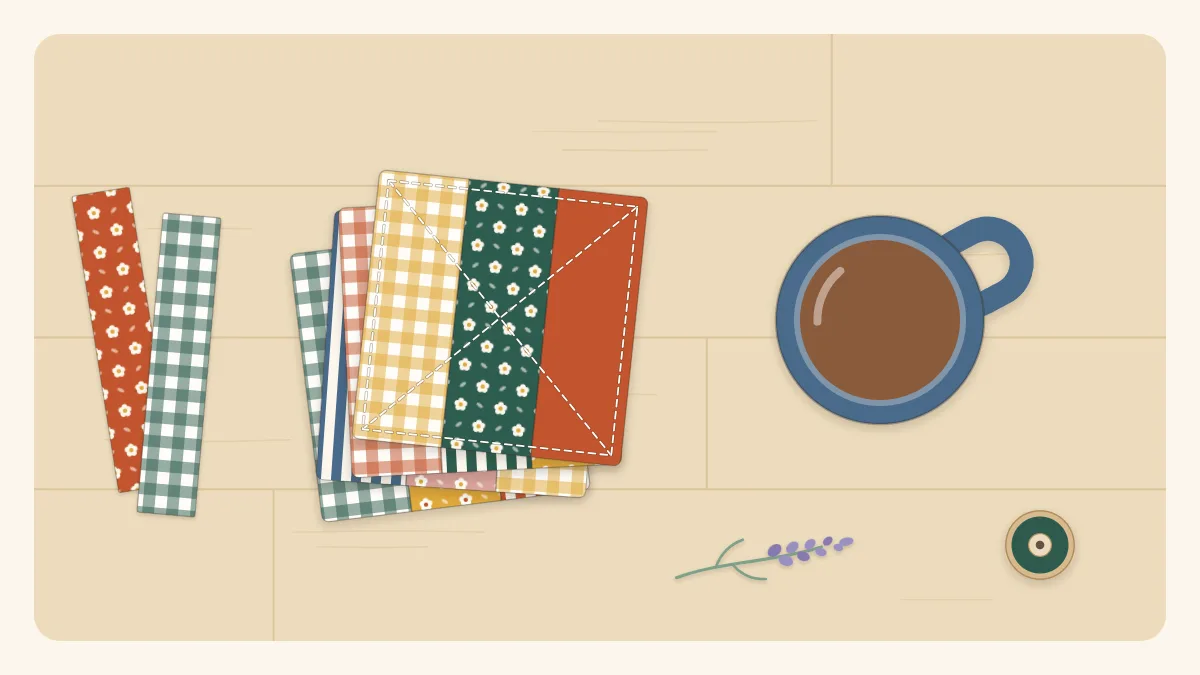
Fabric scrap coasters are one of the most satisfying small projects for a scrap bin: twelve short strips, four backing squares and a little batting turn into a matching set of four. Each coaster is pieced, layered, sewn around the edge, turned right side out and topstitched, so there is no binding to wrestle with. The method teaches accurate seams, clean corners and simple quilting on a piece small enough to finish in one sitting.
Finished size and how the numbers work
Each coaster finishes at 4.5 inches (11.5 cm) square, a comfortable size under a mug or a wide glass. Everything is cut to make a 5-inch (13 cm) square, and the 1/4-inch (6 mm) seam around the outside takes away 1/2 inch (1.3 cm) in each direction.
The patchwork top is made from three strips, each 2 inches wide. Sewn together they lose 1/4 inch at each side of both joining seams: 2 + 2 + 2 = 6 inches, minus 1 inch for two seams, leaves a panel exactly 5 inches wide.
Materials and cutting list
For a set of four coasters:
| Piece | Cut size | Quantity |
|---|---|---|
| Top strips, assorted cotton scraps | 2 x 5 in (5 x 13 cm) | 12 |
| Backing squares | 5 x 5 in (13 x 13 cm) | 4 |
| Thin cotton batting | 5 x 5 in (13 x 13 cm) | 4 |
- Cotton thread in a neutral color, or one that matches the backing
- Rotary cutter, ruler and cutting mat, or scissors and a marking pencil
- Pins or clips, a point turner or chopstick, iron
- Removable fabric marker or a strip of low-tack tape for marking quilting lines
Quilting cotton is the easiest choice. It presses flat, absorbs condensation and washes well. Low-loft cotton batting keeps the coaster flat enough that a glass will not wobble. If strips need trimming to size first, the guide to cutting small fabric scraps covers squaring up odd pieces.
Watch out
A rotary cutter is sharp enough to cut through several layers at once. Close the blade guard every time the cutter is set down, and cut away from the body with the ruler hand well back from the edge.
Step by step
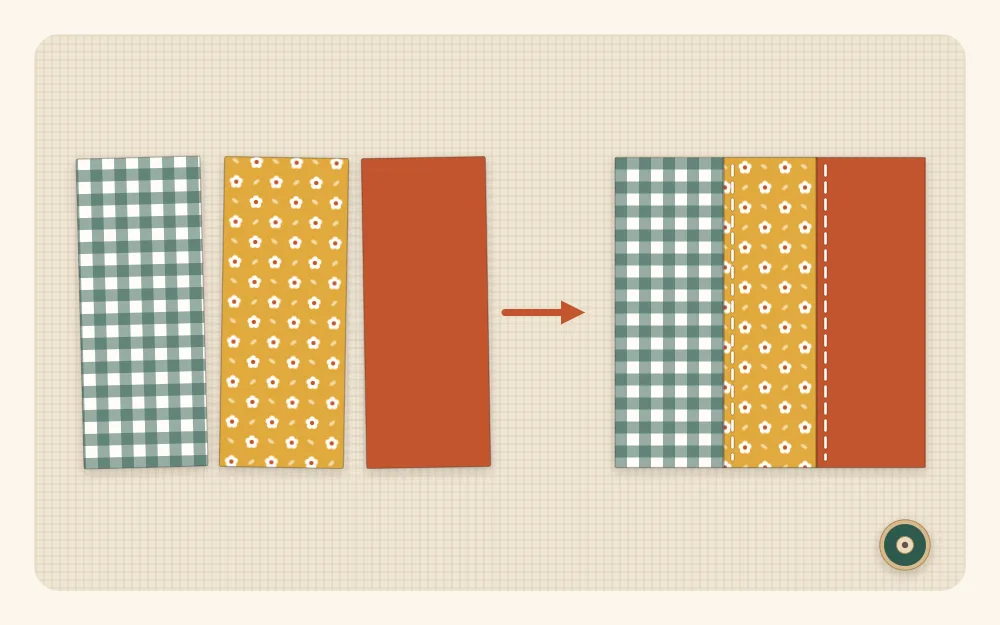
1. Piece the tops
- Arrange the twelve strips into four groups of three. Put the strongest contrast in the middle, or run light, medium and dark across each set. The guide to combining scrap fabric colors explains why contrast in value matters more than matching hues.
- Place two strips right sides together and sew along one long edge with a 1/4-inch seam. Add the third strip to the other side of the middle strip in the same way.
- Press both seams toward the darker fabric, or press them open if the fabrics are thick.
- Measure the panel. It should be 5 inches square. Trim only if an edge is uneven; if the panel is narrower than 5 inches, the seams were too wide, and the backing and batting can be trimmed to match it.
2. Layer and sew
- Stack the layers in this order: batting on the bottom, the pieced top right side up, the backing square right side down. The two fabrics are now right sides together with the batting underneath.
- Pin or clip the edges. Mark a 2-inch (5 cm) gap in the middle of one side. Choose a side where the top’s seams run parallel to the edge, so the gap does not cross a seam.
- Starting at one end of the gap, sew around all four sides with a 1/4-inch seam. Stop 1/4 inch from each corner with the needle down, lift the presser foot, pivot and continue. Backstitch at both ends of the gap.
- Trim the batting close to the stitching to reduce bulk, and clip each corner diagonally, staying a few threads away from the stitches.
3. Turn and press
- Reach through the gap, between the top and the backing, and turn the coaster right side out. The batting ends up sandwiched inside.
- Push the corners out gently with a point turner or the blunt end of a chopstick. Do not use scissor tips, which can poke through.
- Roll the seams between the fingers so they sit right at the edge. Fold the raw edges of the gap inward by 1/4 inch so they line up with the sewn edge, and press the whole coaster flat.
4. Topstitch and quilt
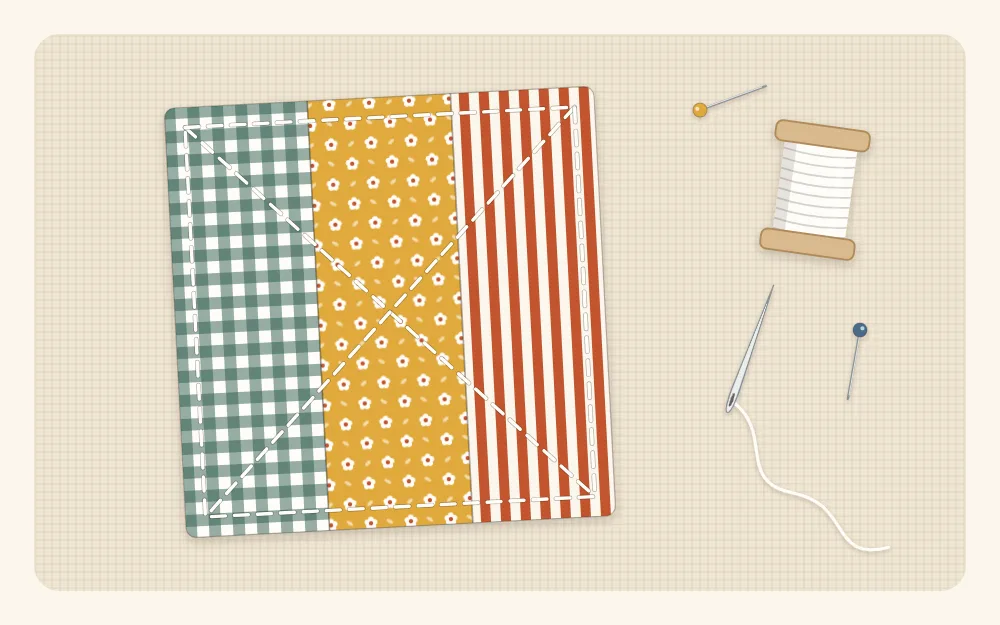
- Lengthen the stitch slightly, to about 3 mm. Topstitch 1/8 inch (3 mm) from the edge all the way around. This closes the gap and keeps the edge crisp.
- Mark a line from corner to corner in both directions, forming an X. A ruler and a removable marker work, or lay a strip of low-tack tape and stitch along its edge.
- Stitch along both lines, starting and stopping on the topstitching at the corners. Pull thread tails to the back and knot them, or backstitch two stitches.
- Give the coaster a final press. Repeat for the other three.
Tip
Sew the set assembly-line style. Piece all four tops, press them together, layer all four, then sew, turn and topstitch. Repeating each step four times in a row gives more even results than finishing one coaster at a time.
Common mistakes and how to avoid them
- Rounded, lumpy corners. Usually caused by skipping the corner clipping or leaving batting in the seam allowance. Trim the batting close and clip the corners before turning.
- A visible dip at the gap. The folded-in edges were not pressed level with the rest of the side. Press and pin or clip the gap before topstitching.
- Coasters of different sizes. Seam widths drifted. Check each pieced top against a 5-inch square before layering.
- Puckers under the quilting. The layers shifted. Pin through the center before quilting and stitch both diagonals from the same pressed, flat state, smoothing outward as the coaster feeds through.
- Batting on the wrong side. If the batting is stacked between the two fabrics before sewing, it ends up on the outside after turning. It always goes on the very bottom, under the top panel.
Variations
- Four-patch tops. Cut four 2.75-inch (7 cm) squares per coaster. Two squares sewn together and then joined in pairs make the same 5-inch panel. The basics are covered in patchwork for beginners.
- Narrow strings. Use five strips 1.5 x 5 inches (3.8 x 13 cm). Five strips total 7.5 inches, minus 2 inches for four seams, leaves 5.5 inches; trim the panel evenly to 5 inches.
- Single-fabric tops. Cut a plain 5-inch square from a favorite print and let the quilting do the decorating: parallel lines 1/2 inch apart, or a square spiral.
- Reversible sets. Piece both sides. Press seams open on both panels so the edges are not too thick to turn neatly.
- Larger mats. The same method scales up to a mug rug or trivet-sized mat for the table. Anything meant for hot cookware needs different materials, as explained in the scrap fabric pot holder tutorial.
Care
Cotton coasters can go through a regular machine wash and be dried flat or on low heat. A quick press afterward restores the shape. Prewashing the scraps before sewing helps the set shrink evenly, which matters most when the fabrics came from different sources.
Frequently asked questions
What batting is best for fabric coasters?
Thin, low-loft cotton batting works well. It keeps the coaster flat so a glass sits steady, and cotton absorbs condensation. A layer of cotton flannel is a workable substitute if no batting is on hand.
Can coasters be made without batting?
Yes, but they will be thin and less absorbent. Two layers of flannel or a piece of an old cotton towel between the top and backing gives a similar result to batting.
Why are my coasters smaller than 4.5 inches?
The seams were probably wider than 1/4 inch, either when joining the strips or when sewing around the edge. Check each pieced top against a 5-inch square before layering and sew the outer seam with a 1/4-inch guide.
Are fabric coasters washable?
Cotton coasters can be machine washed and dried flat or on low heat, then pressed. Prewashing the scraps before sewing helps the finished set shrink evenly.