Scrap Fabric Glasses Case: A Soft Padded Slip-In Sleeve
A soft, padded, fully lined glasses case made from three 8 x 7.5 inch rectangles, with every raw edge hidden. Optional snap or flap closure.

Project at a glance
Materials
- Outer fabric 8 x 7.5 in (20.5 x 19 cm)
- Lining fabric 8 x 7.5 in (20.5 x 19 cm), smooth and low-lint
- Thin cotton batting or fusible fleece 8 x 7.5 in
- Thread, pins or clips
- Hand-sewing needle and point turner
- Optional sew-on snap, about 1/2 in (13 mm)
Glasses that ride around loose in a bag pick up scratches quickly. A scrap fabric glasses case is a soft, padded sleeve that the glasses slip into from the top: an outer fabric, a layer of batting for cushioning, and a smooth lining. It uses three small rectangles and four seams, every raw edge ends up hidden inside, and there is no zipper to fit.
Finished size
The case finishes at about 3.75 x 7 inches (9.5 x 18 cm), which suits most everyday frames and reading glasses. Large or wraparound sunglasses may need more room; the section on resizing below shows how to adjust the cutting sizes.
Materials and cutting list
| Piece | Cut size (width x height) | Notes |
|---|---|---|
| Outer fabric | 8 x 7.5 in (20.5 x 19 cm) | One piece, or a patchwork panel trimmed to this size |
| Lining | 8 x 7.5 in (20.5 x 19 cm) | Soft, smooth, lint-free cotton or flannel |
| Batting | 8 x 7.5 in (20.5 x 19 cm) | Thin cotton batting or fusible fleece |
You will also need thread, pins or clips, an iron, scissors, a hand-sewing needle, and a blunt point turner such as a chopstick. A sew-on snap, about 1/2 inch (13 mm), is optional.
For a pieced outer, sew strips or squares together with 1/4-inch seams until the panel is a little larger than 8 x 7.5 inches, press the seams, and trim. Four strips cut 2.5 x 7.5 inches make a panel 8.5 inches wide, which trims down neatly to 8.
Tip
Choose a tightly woven, low-lint fabric for the lining. Loosely woven or fluffy fabrics shed fibers onto the lenses. Prewashing the lining also removes sizing and loose dye.
How to sew the glasses case
Use a 1/4-inch seam allowance unless a step says otherwise.
- Pad the outer. Lay the batting flat and place the outer fabric on top, right side up. Fuse it if using fusible fleece, or baste the two together 1/8 inch from the edge all the way around. For a quilted look, stitch straight lines about 1 inch apart through both layers now.
- Stack the lining on top. Place the lining right side down on the outer, edges matching, so the stack reads batting, outer, lining. Decide which 8-inch edge will be the opening and clip along it.
- Sew the top edge. Stitch across that 8-inch edge through all three layers.
- Open out and press. Open the lining away from the outer so the piece becomes one long rectangle, 8 x 14.5 inches, with the seam across the middle. Press the seam allowances toward the lining.
- Fold lengthwise. Fold the long rectangle in half lengthwise, right sides together, so it measures 4 x 14.5 inches. The outer is folded onto itself at one end and the lining onto itself at the other. Match the ends of the top seam exactly and clip there first, then along the rest of the raw edges.
- Sew the side and both ends. Starting at the fold, sew across the short end of the outer, pivot at the corner, and sew down the long raw side. Where the seam crosses onto the lining, leave a 3-inch gap in the long side, backstitching on each side of it. Then finish the long side, pivot, and sew across the short end of the lining. On the lining half, drift out to a 3/8-inch seam so the lining ends up slightly smaller and sits smoothly inside.
- Trim. Clip the two stitched corners diagonally, close to but not through the stitching. Trim the batting in the seam allowance back to the stitching to reduce bulk.
- Turn. Pull the whole case through the gap in the lining. Push out the corners of the outer gently with the point turner.
- Close the gap. Fold the gap edges in, press, and stitch them closed by machine very close to the fold, or by hand with a ladder stitch.
- Finish. Push the lining down inside the outer, working it right into the bottom corners. Roll the top seam so it sits exactly on the edge and press. Topstitch 1/4 inch from the top edge all the way around the opening, sewing slowly with the case slipped over the machine’s free arm, or by hand with a small running stitch.
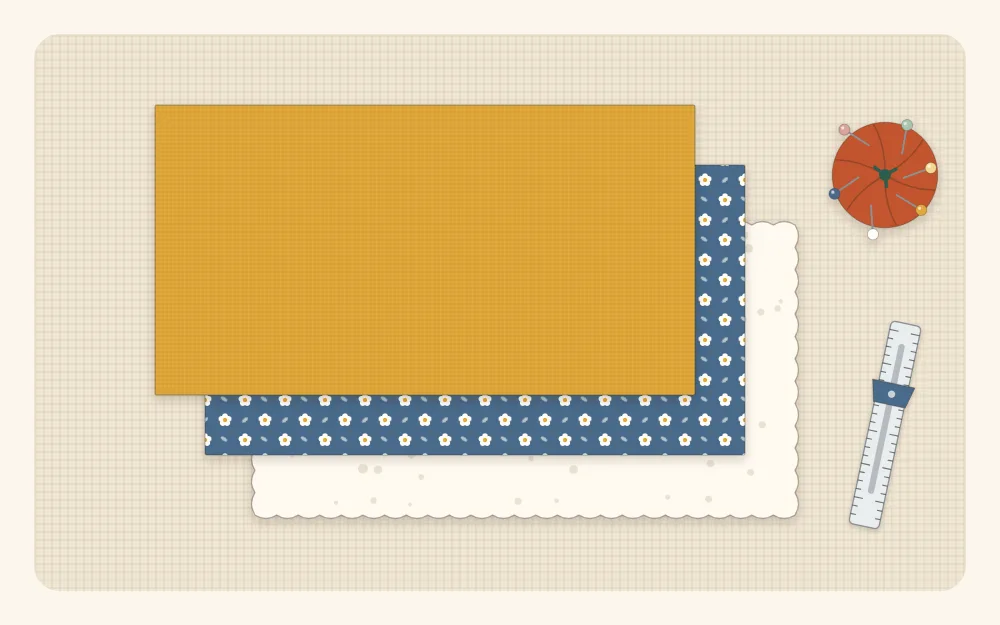
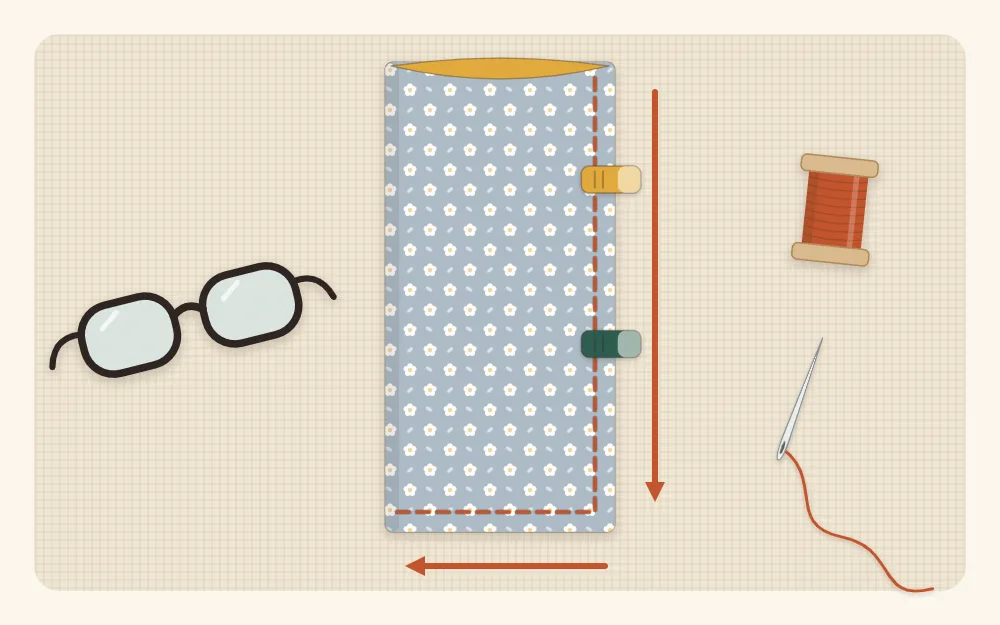
The 8-inch width loses 1/2 inch to the side seam and folds to 3.75 inches; the 7.5-inch height loses 1/4 inch at the top and bottom, giving 7 inches.
Resizing for larger glasses
Fold the glasses and measure their length and their height at the tallest point of the frame. Then work out the cut size like this:
- Cut height = length of the glasses + 1.5 inches
- Cut width = (height of the glasses + 1.25 inches) x 2, then + 1/2 inch
For sunglasses 6.25 inches long and 2.5 inches tall, that is 7.75 inches high and 8 inches wide. Cut all three pieces to the same size.
Optional snap or flap
Snap: after the case is finished, hand-sew the two halves of a sew-on snap to the inside of the opening, centered on the front and back, 1/2 inch below the top edge. Stitch through the lining and batting only so nothing shows on the outside.
Flap: cut two fabric pieces 3.25 x 3.5 inches. Sew them right sides together around both long sides and one short side, clip the corners, turn and press; the flap is 2.75 inches wide. Before step 2, lay the flap on the right side of the outer with its raw edge on the top edge, starting 3/4 inch in from one side, and baste. That centers it on the back half of the case. It is caught in the top seam and extends 3 inches, enough to fold over the front and fasten with a snap.
Watch out
A soft case protects against scratches, not against crushing. Glasses carried in a tightly packed bag or a back pocket still need a rigid case. Snaps and other small fastenings are not suitable for children under three.
Common mistakes
- The top seam does not line up at the side. Clip that junction first in step 5, with the seam allowances lying the same way on both halves.
- A baggy lining. Sew the lining half with the slightly wider 3/8-inch seam, and push it right into the corners before topstitching.
- Batting too thick. High-loft polyester batting makes the case stiff and too tight. Use a thin, flat batting.
- The gap left in the outer. The opening for turning belongs in the lining, where the closing stitches are hidden inside the case.
Variations
- Piece the outer from narrow strips; the basics of accurate seams are covered in patchwork for beginners.
- Add a small shape cut from a contrasting print to the front before step 1, using the method in scrap fabric appliqué for beginners.
- Make a zipped companion for a cleaning cloth and spare screws with the scrap fabric zipper pouch.
Frequently asked questions
What size fabric is needed for a glasses case?
Three rectangles, each 8 inches wide and 7.5 inches high: one outer, one lining and one batting. With 1/4-inch seams they make a case about 3.75 x 7 inches.
What is the best lining for a glasses case?
A smooth, tightly woven cotton or a soft cotton flannel that does not shed. Avoid loosely woven or fluffy fabrics, which leave lint on the lenses.
Does a soft glasses case need a closure?
Not necessarily. A snug slip-in sleeve holds glasses well on its own. A sew-on snap or a short flap adds security if the case will be carried upside down in a bag.
How can the case be made bigger for sunglasses?
Measure the folded glasses. Cut height is the length plus 1.5 inches. Cut width is the frame height plus 1.25 inches, doubled, plus 1/2 inch. Cut the outer, lining and batting to that size.