String Quilt Block: Foundation Piecing With Narrow Scraps
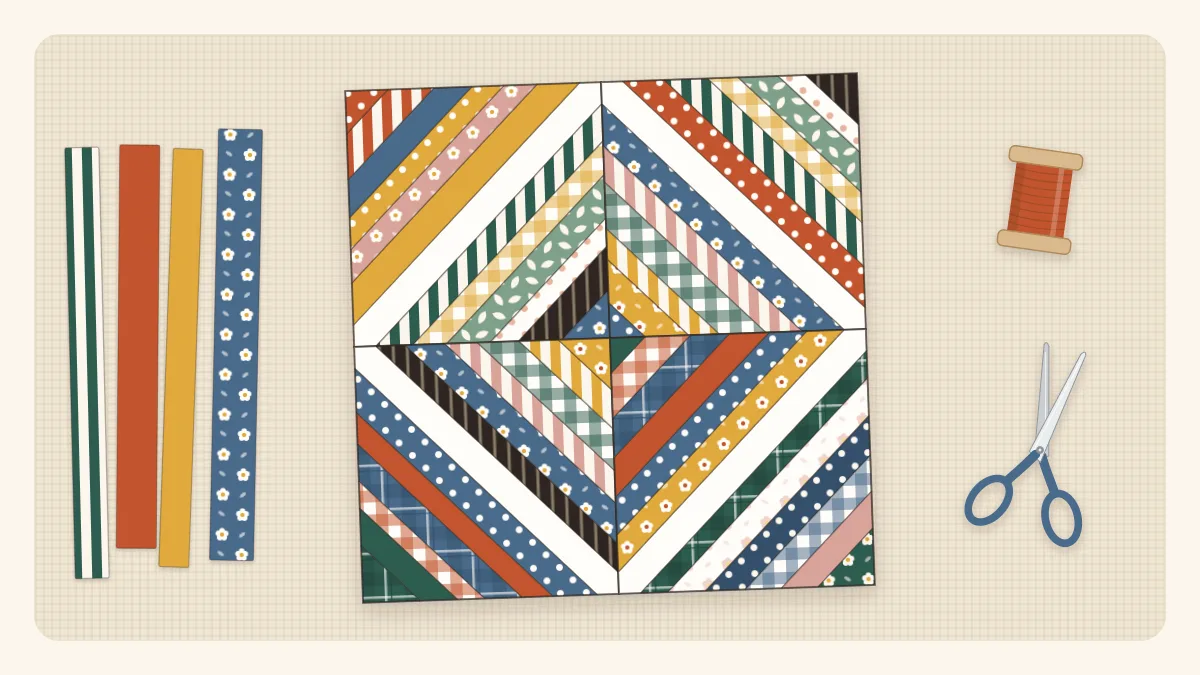
Sew narrow scrap strips onto a paper or muslin foundation, starting from a diagonal center strip, then set four blocks together to form a diamond.
Project at a glance
Materials
- 4 foundation squares, 6.5 x 6.5 in (16.5 x 16.5 cm), thin paper or muslin
- 4 center strips, 1.5 x 10 in (3.8 x 25.5 cm), same fabric
- Assorted fabric strings, 3/4 to 2 in (2 to 5 cm) wide
- Thread, pins or fabric glue stick
- Pencil, ruler, rotary cutter, cutting mat and square ruler
- Iron
In quilting, a “string” is a long, narrow scrap, often too skinny or too uneven to cut into proper strips. A string quilt block puts those leftovers to work by sewing them side by side onto a square foundation of paper or thin fabric, starting with one strip laid diagonally from corner to corner. The foundation keeps everything stable, so the strings can be any width, slightly wedge-shaped, even a little off grain, and the block still comes out flat and square.
Paper or muslin foundation?
| Paper | Muslin or thin cotton | |
|---|---|---|
| After sewing | Torn away | Stays in the block |
| Weight of finished block | Light, same as ordinary patchwork | Heavier, with an extra layer |
| Best for | Quilts that will have batting | Cushions, bags, summer-weight quilts without batting |
| Stitch length | Short, about 1.5 mm, to perforate the paper | Normal, about 2.5 mm |
For paper, choose something thin that tears easily, such as newsprint, tracing paper or lightweight copy paper. For fabric, use prewashed muslin or any thin, pale cotton. Worn sheets work well.
Materials and cutting list
These quantities make four blocks that join into one 12-inch (30.5 cm) finished diamond unit.
- 4 foundation squares, each 6.5 x 6.5 inches (16.5 x 16.5 cm)
- 4 center strips, each 1.5 x 10 inches (3.8 x 25.5 cm), all from the same fabric
- Assorted strings, 3/4 inch to 2 inches (2 to 5 cm) wide and 3 to 9 inches long
- Thread, pins or a fabric glue stick, pencil and ruler
- Rotary cutter, mat and a square ruler at least 6.5 inches
- Iron
The diagonal of a 6.5-inch square is about 9.2 inches, which is why the center strip is cut 10 inches long. Strings need at least one reasonably straight long edge; trim a wavy edge with the rotary cutter first. If the scrap bin has not been organized yet, sorting fabric scraps by shape makes it easy to pull out every string at once.
How to sew a string quilt block
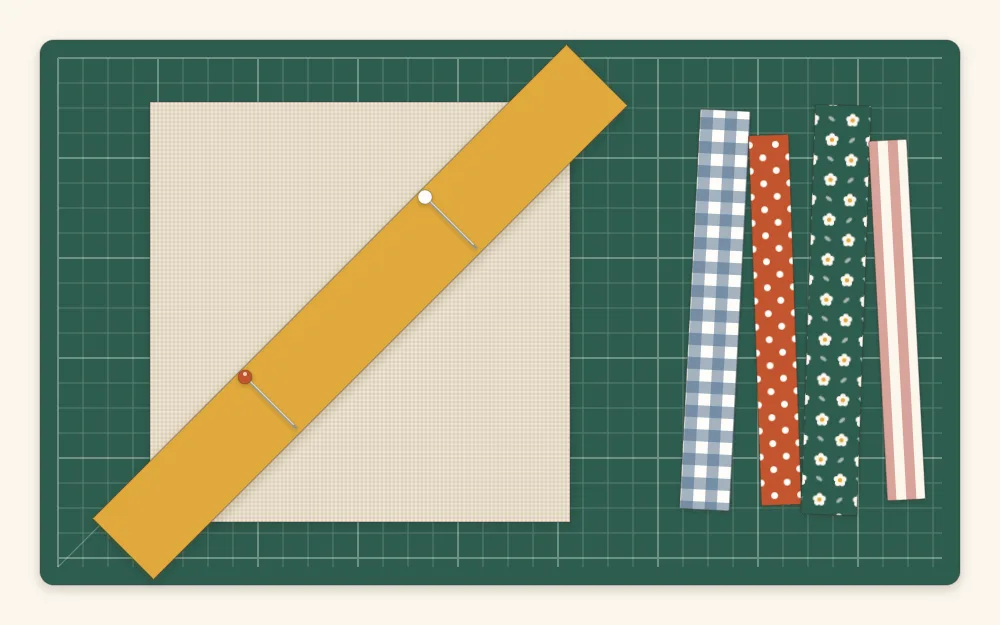
- Mark the foundation. Draw a line from one corner of the foundation square to the opposite corner. Draw a second line parallel to it, 3/4 inch to one side. The second line is the placement guide for the center strip.
- Place the center strip. Lay the center strip right side up with one long edge on the guide line, so the strip is centered over the diagonal with 3/4 inch on each side. Let it overhang both corners. Hold it with a dab of glue stick or two pins.
- Add the first string. Choose a string long enough to overhang the foundation at both ends. Place it right side down on the center strip, long edges matching along one side.
- Sew. Stitch 1/4 inch from the matched edges, through both fabrics and the foundation, from one edge of the foundation to the other.
- Flip and press. Fold the string over so it is right side up and press it flat against the foundation. Make sure there is no tuck along the seam.
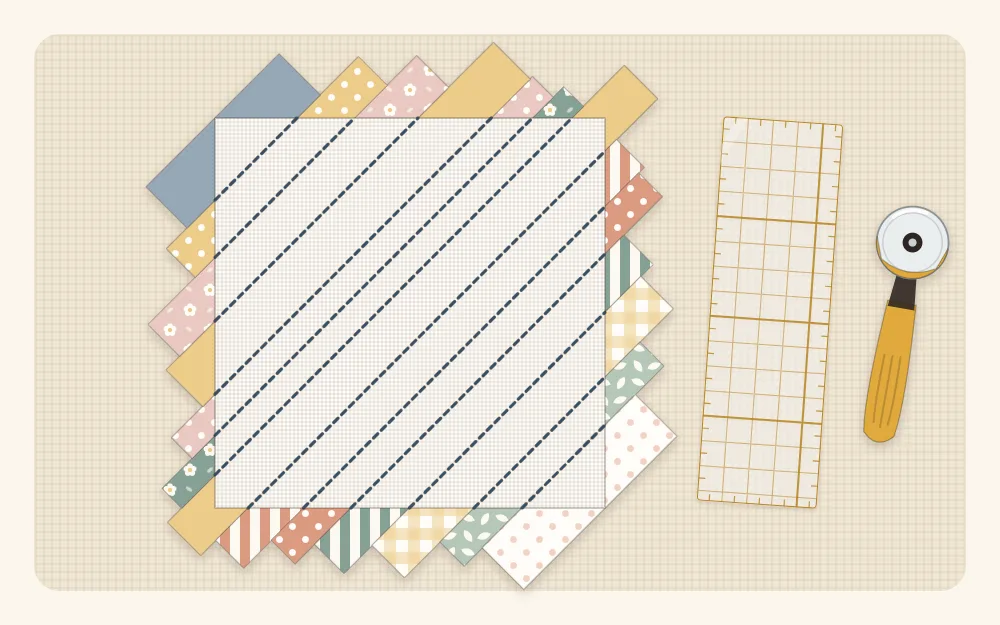
- Keep going. Place the next string right side down on the raw edge of the one just pressed, sew, flip and press. Each string is shorter than the last. Continue until the corner of the foundation is completely covered.
- Finish the corner with a wide piece. Make the last piece in each corner at least 2 inches wide, so no seam falls within the corner’s seam allowance.
- Cover the other half. Turn the block around and repeat from the other edge of the center strip out to the opposite corner.
- Trim. Turn the block face down. Using the foundation as the guide, lay the ruler along each edge and cut away the overhanging strip ends so the block is exactly 6.5 inches square.
- Stay-stitch if using paper. Sew around the block 1/8 inch from the edge before removing any paper. The edges of a string block are on the bias and stretch easily.
Tip
Wedge-shaped strings, wider at one end than the other, are welcome. Alternate the wide ends from side to side so the strips fan gently instead of all leaning one way.
Why the center strips line up
The center strip is cut 1.5 inches wide and loses 1/4 inch along each long edge to seams, so it shows as a 1-inch band centered on the diagonal. Because every block uses the same placement line, the bands meet at the same point on every block edge, and the diamond closes neatly.
Arranging four blocks into a diamond
- Lay the four blocks in a two-by-two square.
- Turn each block so its center strip cuts across its outer corner, running between the midpoints of the outside edges of the group. The four strips form a square standing on its point. If the strips all meet in the middle instead, they form an X; turn every block a quarter turn.
- Sew the top two blocks together with a 1/4-inch seam, pinning where the center strips meet. Sew the bottom two the same way.
- Press the seam of the top pair one way and the bottom pair the other. Open seams are a good choice if the join feels thick.
- Sew the two pairs together, matching the center seam and the strip ends.
Two 6.5-inch blocks joined make 12.5 inches, so the four-block unit measures 12.5 inches square and finishes at 12 inches in a quilt.
Removing the paper
Leave paper in place until the blocks are sewn to each other; it protects the stretchy edges. Then fold the paper back along each seam, crease it, and tear it away gently while supporting the stitches with a finger. Tweezers lift out the small pieces caught under seam crossings.
Watch out
Use a dry iron on paper foundations; steam makes paper curl and can distort the block. If glue stick is used to hold the center strip, keep it to a small dab away from the seam lines so the paper tears off cleanly.
Common mistakes
- Strings too short. A string that does not reach both edges of the foundation leaves a gap. Check the length before sewing.
- Normal stitch length on paper. Long stitches make paper hard to tear and can be pulled loose when it is removed.
- Center strips placed by eye. Even a small shift shows when four blocks meet. Use the drawn guide line every time.
- Trimming from the front. The foundation is the true 6.5-inch square, so trim with the block face down.
Variations
- Light center, dark center. A pale center strip makes the diamond glow against dark strings; a dark one outlines it. Value matters more than color here, as explained in combining scrap fabric colors.
- Cushion size. Four blocks made on 8.5-inch foundations give a 16.5-inch panel, the exact front size for the patchwork cushion cover with an envelope back. Cut those center strips 13 inches long.
- Pieced strings. Join short ends into longer strings first, or use strips of crumb piecing made as described in crumb quilting blocks.
Frequently asked questions
What is a string in quilting?
A string is a long, narrow scrap of fabric, usually between about 3/4 inch and 2 inches wide, and often uneven in width. String piecing sews these side by side onto a foundation.
Is paper or fabric better as a foundation for string blocks?
Paper is torn away afterward and leaves a light block, which suits quilts with batting. Muslin stays in and adds a layer, which suits cushions, bags and light quilts made without batting.
How do the center strips form a diamond?
Each block has one strip running corner to corner. When four blocks are arranged two by two with each strip crossing the outer corner of its block, the four strips join into a square standing on its point.
When should the paper be removed from a string block?
After the blocks have been sewn to each other. Until then the paper supports the bias edges and keeps the blocks from stretching out of shape.